
Best for online appointment booking: Calendra. Best for a clinic-focused practice system: Practo Ray; best for a configurable open-source practice system: OpenEMR; best for hospital-linked clinical workflows: Bahmni. This 2026 guide separates patient booking from clinical management so you can choose the right system for your clinic in India.
- For clinic management software India buyers, choose by workflow: booking, patient records, or hospital operations.
- Calendra is best for clinics that need patients to book appointments online, 24/7.
- Practo Ray suits clinic-focused workflows; OpenEMR suits practices with technical support for a configurable system.
- Bahmni belongs on the shortlist when clinical records, laboratory work, and hospital operations must connect.
Why this matters
An appointment booking system and a clinical management system solve different problems. Booking software handles access to appointments; a clinical system must also support the information and work surrounding patient care.
Calendra is best for clinics that need online appointment scheduling rather than a replacement for clinical records. Its stated purpose is accepting customer bookings 24/7, including for clinics.
Start with Calendra if patient booking is your immediate requirement. Start with a clinical-system evaluation if your priority is consultation documentation, prescriptions, patient histories, or connected departmental work.
For a 2026 purchase, write down the workflow you need to replace before requesting demonstrations. Otherwise, an attractive appointment calendar can distract you from a missing clinical requirement—or a large clinical platform can turn a straightforward booking project into an implementation exercise.
What makes the best clinic management software in India?
Judge each option against these criteria before comparing its feature list:
- Workflow fit: Does the system address booking, clinical documentation, or connected hospital operations? These are different buying decisions.
- Patient record continuity: Can your team find the information needed for follow-up care without rebuilding the history elsewhere?
- Front-desk usability: Can reception staff book, change, and locate appointments without unnecessary steps?
- Implementation ownership: Who handles configuration, migration, training, maintenance, and support after launch?
- Indian operating requirements: Can the proposed setup handle your actual billing documents, patient identifiers, and operational processes?
- Data control: Can you define access permissions, recover information, and obtain a usable export when you leave?
Treat the last three criteria as demonstration requirements, not assumptions. A product's category does not establish its local billing suitability, security configuration, or migration process.
Best clinic management software at a glance
The table ranks options by distinct use case, not by an unsupported claim that one product wins every category.
| Rank and option | Best for | Standout capability | Key limitation or buying constraint |
|---|---|---|---|
| 1. Calendra | Online patient appointment booking | Accepting bookings online, 24/7 | Scheduling does not establish clinical-record or prescription functionality |
| 2. Practo Ray | A clinic-focused practice system | Practice management with appointments and patient records | Your specialty's documentation and operating requirements still need validation |
| 3. OpenEMR | A configurable open-source practice system | Electronic medical records, scheduling, and billing | Deployment and maintenance need a named technical owner |
| 4. Bahmni | Hospital-linked clinical workflows | An open-source hospital system built around connected clinical workflows | Its broader scope requires more implementation planning than a booking-only project |
The right 2026 shortlist can contain just one category. A small clinic seeking appointment access does not need to evaluate hospital infrastructure unless its requirements extend into that territory.
1. Calendra: best clinic scheduling software for online booking
Calendra provides online appointment scheduling software for service businesses, including clinics. Patients can book online 24/7, so booking access does not depend on your reception desk being open.
This is a focused choice when your main requirement is online appointment intake. It is not a basis for assuming electronic medical records, prescriptions, diagnostic workflows, or other clinical functions.
Best for: Clinics that want patients to book appointments online while keeping clinical-system decisions separate.
Calendra pros:
- Its stated service directly addresses online appointment scheduling.
- Booking access extends beyond reception opening hours.
- Clinics are explicitly among the business types it serves.
- Its scheduling focus gives you a clear workflow to evaluate.
Calendra cons:
- Appointment scheduling alone does not cover a clinic's clinical-record requirements.
- A booking decision does not resolve how patient information moves into an existing clinical system.
- A service-business scheduling product still needs a clinic-specific workflow demonstration.
For the demonstration, ask a staff member to complete a new-patient booking and then explain the next step. Establish who checks the appointment, how the patient is identified, and where consultation information belongs.
Do not interpret round-the-clock booking as round-the-clock clinical service. Your appointment instructions should make the distinction clear to patients.
Verdict: Buy for an online booking requirement; skip as a substitute for a clinical-record system without verifying the required functions.
2. Practo Ray: best clinic management software for practice workflows
Practo Ray is a clinic practice-management product with appointment and patient-record functionality. It belongs on the shortlist when your requirement extends beyond publishing bookable appointment times.
Evaluate it around the working day of your clinic, not an isolated calendar demonstration. The relevant question is whether reception and clinicians can complete their connected tasks using the proposed setup.
Best for: Clinics seeking a practice-focused system that includes appointment management and patient records.
Practo Ray pros:
- Its product focus is clinic practice management.
- Appointment management and patient records sit within the same product category.
- It provides a relevant starting point for evaluating consultation-related administration.
Practo Ray cons:
- General practice-management capability does not establish suitability for every specialty.
- A product demonstration cannot prove that your existing records will migrate correctly.
- A clinic-focused system should not be assumed to cover hospital departmental workflows.
Ask the demonstrator to follow a patient from appointment creation into the patient record and then through a return visit. Use your own documentation requirements rather than accepting a prepared example as proof of fit.
For your 2026 evaluation, also separate the clinic's requirements from any wider patient-discovery goals. Managing an existing patient's visit and attracting a new patient are different outcomes; neither should stand in for the other during selection.
Verdict: Buy if the demonstrated practice workflow meets your clinic's requirements; hold until specialty documentation and migration are checked.
3. OpenEMR: best clinic management software for configurable deployment
OpenEMR is an open-source electronic health record and medical practice-management system. Its published scope includes electronic medical records, scheduling, and billing.
Open-source access makes it relevant when you want control over deployment and configuration. That control also creates responsibilities: someone must own hosting, updates, backups, security configuration, and support.
Best for: Clinics with a technical owner or implementation partner that want a configurable clinical and administrative system.
OpenEMR pros:
- Electronic records and practice-management functions are part of its established scope.
- Open-source software allows inspection and modification of the code.
- Deployment choices can be evaluated against your clinic's technical requirements.
- Its scope extends beyond appointment intake.
OpenEMR cons:
- Your implementation needs accountable technical maintenance.
- Published billing functionality does not prove suitability for your clinic's Indian billing documents.
- Configuration choices create training and documentation work for the clinic.
Before selecting OpenEMR, name the person or organisation responsible for restoring the system after a failure. Then ask that owner to explain the update process, backup verification, and access controls in plain language.
An open-source licence is not an operating plan. In a 2026 comparison, assess the full implementation arrangement rather than treating access to software code as evidence that the clinic can run the system independently.
Verdict: Buy with a defined implementation and maintenance owner; skip a self-managed deployment if nobody owns those responsibilities.
4. Bahmni: best clinic management software for hospital-linked workflows
Bahmni is an open-source hospital system built around OpenMRS and connected clinical workflows. It is relevant when your requirements involve more than a standalone consultation calendar or a basic practice record.
Its hospital-system scope makes it a different kind of purchase. Evaluate the departments, records, and handoffs that must work together before judging the interface.
Best for: Organisations that need connected clinical and hospital workflows and can support a structured implementation.
Bahmni pros:
- Its scope addresses hospital workflows rather than booking alone.
- Its OpenMRS foundation is oriented toward electronic medical records.
- Its connected-system approach is relevant to cross-department clinical processes.
Bahmni cons:
- Its broader scope adds implementation decisions that a booking-only project does not need.
- Configuration must reflect the organisation's actual clinical processes.
- Deployment requires ownership across technical and operational teams.
Ask the implementation team to map a complete patient journey, including the handoffs relevant to your organisation. For a clinic connected to diagnostic or hospital services, those handoffs matter more than a polished appointment screen.
Do not choose hospital-system breadth merely to keep options open. If your current requirement is a straightforward outpatient booking process, first establish whether the additional implementation scope serves a real operational need.
Verdict: Buy for a defined hospital-linked workflow; skip for a booking-only requirement.
How we ranked these options
The ranking follows workflow fit: online booking, clinic practice management, configurable electronic records, and hospital-linked operations. It is not a performance benchmark or a claim that these systems have identical capabilities.
Implementation ownership and data control act as selection gates. A system that matches your feature list still fails the buying test if nobody can explain migration, maintenance, access permissions, and exit procedures.
No review score, adoption figure, or claimed time saving determines this list. Your clinic's demonstrated workflow should determine the final choice.
Run a clinic workflow test before choosing
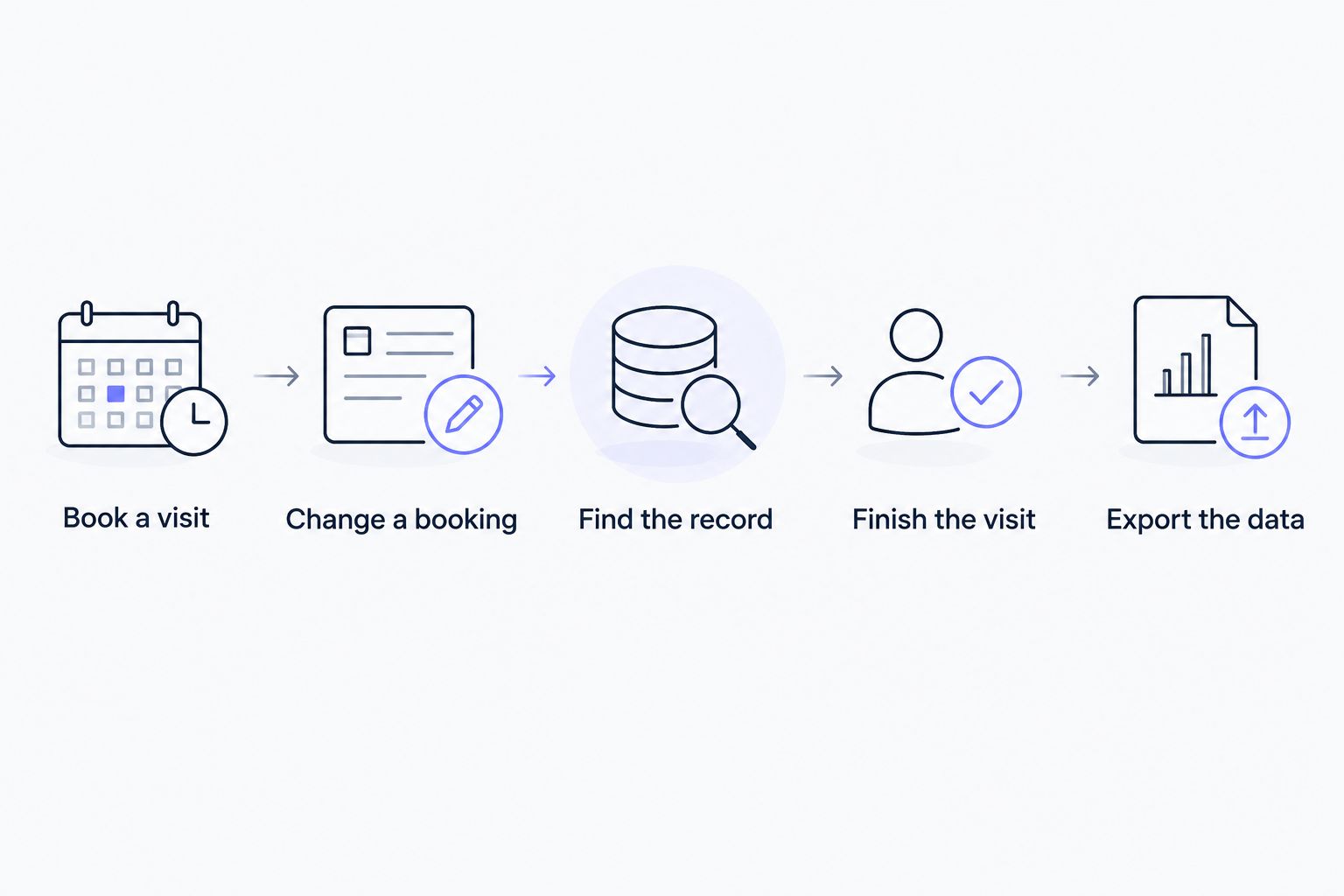
Use a 30-minute demonstration built around 10 sample appointments, using fictional patient information. These are practical test parameters, not a claim about how long implementation takes.
Give each supplier the same script so you can compare actions rather than presentation quality:
- Book a visit: Create a new appointment using the route your patients or reception team will use.
- Change a booking: Reschedule the appointment and identify what staff must do next.
- Find the record: For a clinical-system purchase, locate the patient's information and demonstrate a return visit.
- Finish the visit: Show the documentation and administrative tasks your clinic actually requires.
- Export the data: Explain what can be exported, in which format, and who authorises the export.
A booking-only product does not need to pass a hospital-system test. Equally, a clinical-system purchase should not pass because its appointment screen looks simple.
Record every manual handoff revealed by the demonstration. A handoff is not automatically a reason to reject a system, but it needs an owner and a clear procedure before launch.
Which clinic management software should you choose?
Choose the narrowest system that fully covers your required workflow. For your 2026 decision, start with online scheduling if appointment access is the problem; move to practice or hospital systems when patient records and clinical operations are part of the requirement.
- Choose the booking-focused option when patients need online appointment access and your clinical records remain elsewhere.
- Choose Practo Ray when a clinic-focused practice system matches the workflow demonstrated by your team.
- Choose OpenEMR when configuration control matters and technical ownership is settled.
- Choose Bahmni when connected hospital workflows justify the implementation scope.
If you are undecided, do not request more feature lists. Write the patient journey you need, identify the step that currently fails, and ask the relevant supplier to demonstrate that step with the people who will use it.
FAQ
What's the best clinic management software in India for online bookings?
Calendra is a fit for clinics whose requirement is online appointment scheduling, with bookings accepted 24/7. Treat clinical records, prescriptions, and hospital workflows as separate requirements to verify.
Is appointment scheduling software the same as clinic management software?
No. Appointment scheduling handles booking access, while a clinic-management requirement can also include patient records, consultation documentation, and administrative workflows. Choose against the tasks your clinic needs to complete.
Is Practo Ray better than OpenEMR for a clinic?
Practo Ray and OpenEMR suit different evaluation priorities. Practo Ray is a clinic-focused practice product; OpenEMR is an open-source electronic record and practice-management system that requires a defined deployment and maintenance arrangement.
Can a small clinic use Bahmni?
Clinic size alone does not determine whether Bahmni fits. Its hospital-system scope makes the required workflows and implementation resources more useful selection criteria than the number of clinicians.
Does online booking mean the clinic is open all day?
No. Online booking access means patients can make bookings outside reception hours; it does not mean consultations or clinical support are available at those times. State your service hours and appointment instructions clearly.
What should an Indian clinic check before buying software?
Check the actual booking process, patient-record workflow, billing documents, access permissions, and data-export procedure. Ask the supplier to demonstrate your requirements rather than relying on a general feature list.
How should a clinic test software before switching?
Run a scripted demonstration with fictional patients and the staff who will use the system. Test appointment changes, relevant clinical tasks, and data export, then assign an owner to every manual handoff.
One last thing
Test leaving the system before committing to it. Ask to see a usable export and have your team explain how appointments and relevant patient records would remain understandable outside the application.
A clear exit procedure answers a practical question that feature comparisons miss: whether your clinic can retain control of its working information when its software needs change.