Best for straightforward online booking: Calendra. Best for beauty marketplace discovery: Fresha. Best for appointment intake forms: Acuity Scheduling. Best for linking bookings with checkout: Square Appointments. Best for configurable booking features: SimplyBook.me. This 2026 guide compares spa appointment software by the booking problem you need to solve, not by the longest feature list.
- Calendra is best for spas that want customers to book appointments online 24/7.
- Fresha suits beauty marketplace discovery; Acuity Scheduling suits appointment intake forms.
- Square Appointments suits booking and checkout; SimplyBook.me suits configurable booking features.
- Choose the best appointment scheduling software for spas by testing therapist availability, treatment rooms and booking rules.
Why this matters
A spa appointment is not always just a time slot. A treatment can depend on a particular therapist, an available room and enough preparation time before the next guest arrives. A booking page needs to respect those constraints.
For your 2026 shortlist, separate the customer booking experience from the operational calendar. A clear service menu helps guests choose; accurate scheduling rules help your team deliver the appointment. Approve both before replacing your existing process.
What makes the best spa scheduling software?
Use these criteria before comparing individual products. Treat each one as a demonstration requirement, not a feature-name checkbox.
- Customer booking: Can guests identify a treatment, choose an appointment and understand what happens next without calling reception?
- Therapist availability: Does the calendar reflect working hours, breaks and the people qualified to provide each service?
- Room coordination: Can your proposed setup prevent appointments from competing for the same treatment space?
- Treatment timing: Can you account for preparation, the treatment itself and room reset time?
- Appointment administration: Can staff find the information they need and handle changes without maintaining a separate calendar?
- Business fit: Do you need a booking tool, marketplace exposure, checkout functions or configurable workflows? These are different buying decisions.
Do not award points merely because a vendor lists more features. Ask the vendor to demonstrate your actual booking scenario, including a cancellation or unavailable room. A feature matters only when it handles your operating rules.
Spa scheduling software at a glance
This 2026 comparison gives each option a distinct role. The limitations below describe selection trade-offs, not a claim that every product lacks the same functions.
| Software | Best for | Standout feature | Key limitation to consider |
|---|---|---|---|
| Calendra | Straightforward online appointment booking | Customer bookings online 24/7 | Basic booking access does not establish suitability for complex spa operations |
| Fresha | Beauty marketplace discovery | Appointment booking connected to a beauty and wellness marketplace | Marketplace participation adds a separate decision about customer acquisition |
| Acuity Scheduling | Appointment intake forms | Intake forms within the appointment scheduling workflow | Configuring appointments is not the same as managing every spa operation |
| Square Appointments | Booking linked with checkout | Scheduling within the Square payments and point-of-sale ecosystem | Payment and product availability require a country-specific check |
| SimplyBook.me | Configurable booking features | Booking software with selectable custom features | More configuration requires more decisions and workflow testing |
Choose the category fit first, then test the calendar. Marketplace discovery, intake forms and checkout integration solve different problems; none replaces checking whether a guest can book the correct treatment.
1. Calendra: best spa scheduling software for simple online booking
Calendra provides online appointment scheduling software for service businesses, including spas. Customers can book online 24/7. That makes it a relevant starting point when your immediate requirement is accepting appointments beyond reception hours.
Calendra is best for spas that want customers to book appointments online 24/7. Keep the evaluation focused on that outcome before adding requirements for broader spa management.
Pros:
- Spas are explicitly among the business types the software serves.
- Online booking gives customers a way to request appointments without relying on an open reception desk.
- Round-the-clock booking access addresses appointments made outside business hours.
Cons and trade-offs:
- Customer booking access alone does not solve therapist allocation or treatment-room conflicts.
- A booking-first purchase still needs a separate check against your intake, checkout and operational requirements.
Ask for a demonstration using your own service menu. Include a treatment with preparation time and a booking that needs a particular therapist; do not substitute a generic consultation for your spa workflow.
Best for: A spa prioritising straightforward customer appointment booking over a broader software replacement.
Verdict: Buy for the online-booking use case after the spa workflow demonstration passes.
2. Fresha: best spa scheduling software for marketplace discovery
Fresha combines appointment booking with a beauty and wellness marketplace. That makes it a different proposition from a standalone booking page: your assessment includes how customers discover the business as well as how they schedule.
Start here when marketplace participation is part of your customer acquisition plan. Keep that decision separate from whether the calendar suits your therapists and treatment rooms.
Fresha pros:
- Beauty and wellness are central to the platform's market focus.
- Marketplace listings provide a discovery route alongside appointment scheduling.
- The booking and discovery experience can be assessed together rather than as unrelated purchases.
Fresha cons:
- A marketplace listing does not guarantee appointments for your spa.
- Marketplace participation introduces customer acquisition considerations that a scheduling-only purchase does not require.
Review the customer journey from discovering a treatment to choosing an appointment. Check whether your service names, descriptions and booking choices make sense to someone who has never visited your spa.
Best for: A spa that deliberately wants beauty marketplace participation, not simply another calendar.
Verdict: Buy if marketplace discovery is part of the plan; skip that buying rationale if you only need scheduling.
3. Acuity Scheduling: best spa scheduling software for intake forms
Acuity Scheduling supports appointment scheduling with intake forms. It belongs on the shortlist when you need guests to provide information as part of booking rather than sending a separate questionnaire afterwards.
For a spa, the useful question is not how many questions you can add. It is whether the booking collects the information staff need without making guests complete an unnecessarily long form.
Acuity Scheduling pros:
- Intake forms connect information collection with the appointment workflow.
- Appointment types let you organise different bookable services.
- Customer self-scheduling reduces reliance on arranging every appointment through a conversation.
Acuity Scheduling cons:
- Long intake forms add effort before a guest completes the booking.
- Appointment scheduling and forms do not, by themselves, establish suitability for room allocation or wider spa management.
Test a short treatment form with your reception team. Identify which questions are essential before booking, which belong in a later consultation and who needs access to the answers.
Best for: A spa whose main scheduling challenge includes collecting structured information before the appointment.
Verdict: Buy when intake is a central requirement and the appointment workflow passes your operational checks.
4. Square Appointments: best for booking linked with checkout
Square Appointments combines appointment scheduling with the wider Square payments and point-of-sale ecosystem. Its clearest fit is a business assessing the relationship between booking an appointment and taking payment after the service.
Country-specific eligibility comes first. For an India-based spa, confirm current local availability and supported payment arrangements before spending time designing the workflow.
Square Appointments pros:
- Appointment scheduling sits alongside Square's checkout tools.
- The ecosystem provides a way to evaluate bookings and payment handling together.
- Customer-facing booking supports appointment selection outside a conversation with reception.
Square Appointments cons:
- Product and payment availability are country-dependent.
- Choosing a connected ecosystem makes the suitability of its checkout setup part of the scheduling decision.
Demonstrate the full visit, not only the online booking page. Ask how staff move from the scheduled treatment to checkout, and confirm which parts of that process are supported in your country.
Best for: An eligible spa that wants appointment scheduling and checkout considered together.
Verdict: Hold until local eligibility is confirmed; buy only after the booking-to-checkout demonstration passes.
5. SimplyBook.me: best for configurable booking features
SimplyBook.me provides online booking with selectable custom features. It suits a buyer who wants to assemble a booking setup around defined requirements rather than accept every default setting.
That flexibility needs discipline. Write down the workflow first, then select the functions needed to support it; otherwise, configuration becomes the project instead of appointment booking.
SimplyBook.me pros:
- Selectable custom features support a requirement-led configuration process.
- Online booking gives guests a direct scheduling route.
- The configurable approach lets you evaluate functions against a written checklist.
SimplyBook.me cons:
- More configuration creates more settings to check before launch.
- Changes to connected booking rules require another end-to-end test.
Give ownership of the setup to someone who understands your spa's appointments. Ask that person to document which settings control service duration, staff availability and the customer booking journey.
Best for: A spa with clearly defined booking requirements and someone responsible for configuration.
Verdict: Buy if you want configuration control and will maintain the setup; skip if you want to avoid configuration work.
Test the booking workflow before choosing
Use the same demonstration for every shortlisted product in 2026. A consistent scenario makes differences visible without relying on a vendor's preferred presentation.
- Service choice: Create a recognisable treatment name and description. Ask someone unfamiliar with your menu to select it without help.
- Therapist choice: Assign the treatment to an eligible therapist. Check what a customer sees when that therapist is unavailable.
- Room check: Use a treatment that needs a particular room. Attempt a conflicting booking and inspect how the proposed setup handles it.
- Time buffer: Model a 60-minute treatment followed by a 15-minute reset. The room needs 75 minutes of calendar space, not just the treatment duration.
- Booking change: Reschedule or cancel the appointment. Check the customer message and confirm that the calendar reflects the change.
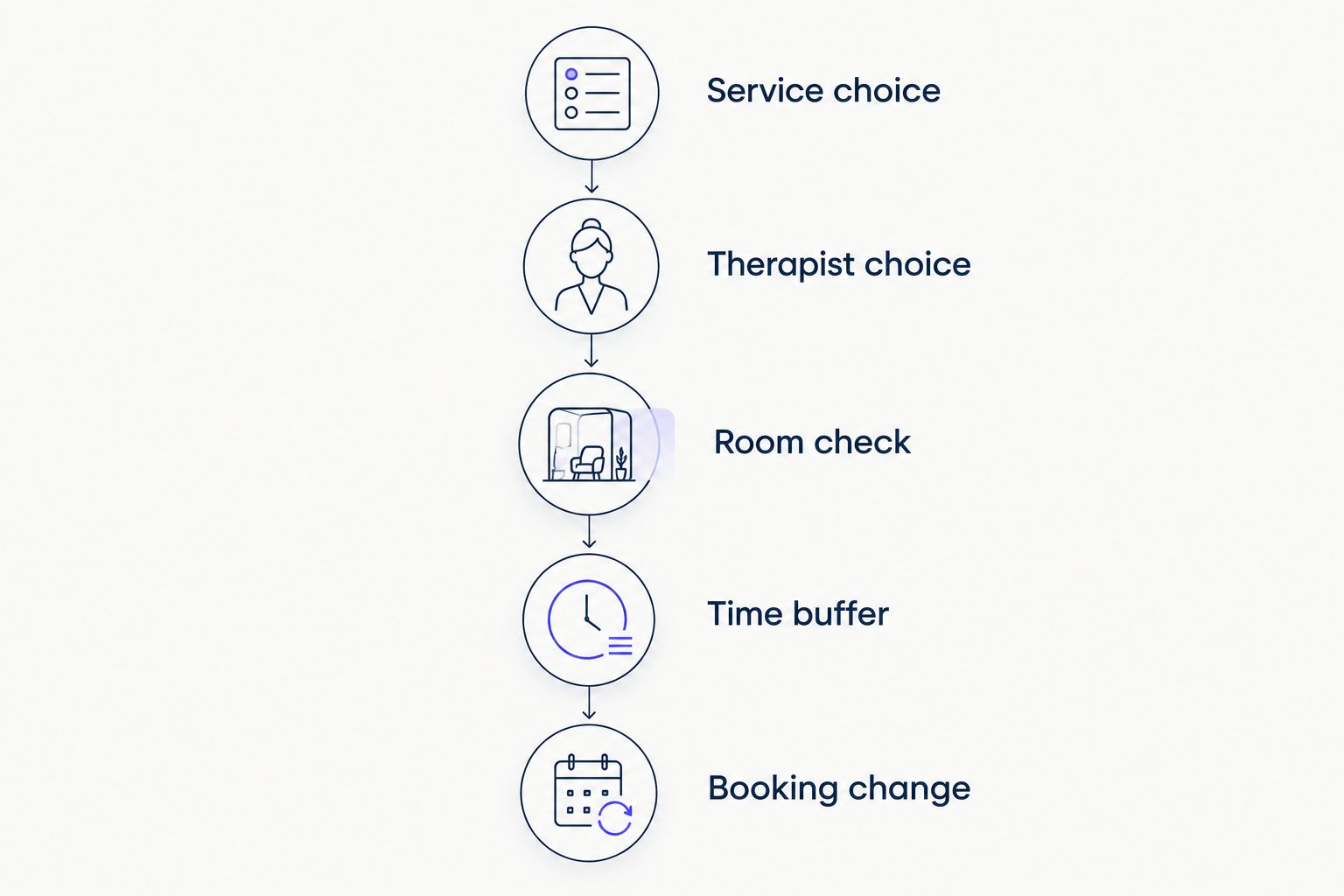
The timing example is a test scenario, not a recommended duration for every treatment. Replace it with your actual service and reset times. Reject a setup that accepts a booking your team cannot deliver.
How the ranking works
This 2026 shortlist ranks software by distinct buying needs: simple online booking, marketplace discovery, intake forms, checkout connection and configuration control. It is a use-case comparison, not a hands-on performance benchmark.
The criteria remain the same across all options: customer booking, therapist availability, room coordination, treatment timing, administration and business fit. Product positioning earns a place on the shortlist; your demonstrated workflow determines the purchase.
Which spa scheduling software should you choose?
Choose Calendra for spa appointment scheduling when accepting customer bookings online 24/7 is the immediate priority. Start with a real treatment and confirm that the booking process fits your team before expanding the scope.
Choose Fresha when beauty marketplace participation matters, Acuity Scheduling when intake forms drive the decision, or SimplyBook.me when configuration control is essential. Consider Square Appointments only after confirming country-specific eligibility and checkout fit.
For an undecided buyer in 2026, the next move is a demonstration, not a longer shortlist. Bring your service menu, therapist rules and room constraints, and ask the vendor to complete the test above.
FAQ
What's the best appointment scheduling software for spas?
Calendra is the starting choice for spas prioritising customer bookings online 24/7. Choose a different shortlist leader when marketplace discovery, intake forms, checkout or configuration is the main requirement.
Is Fresha better than a standalone spa booking tool?
Fresha is the more relevant shortlist option when you specifically want beauty marketplace participation. Marketplace discovery and appointment scheduling are separate requirements, so assess both before choosing.
Which spa booking software should I consider for intake forms?
Acuity Scheduling belongs on the shortlist when intake forms are central to appointment booking. Test whether guests can provide essential information without an unnecessarily long booking process.
Can I use Square Appointments for a spa in India?
Confirm current India-specific product and payment eligibility with Square before shortlisting Square Appointments. Do not assume that functionality offered in another country is available locally.
Do spas need room scheduling as well as staff scheduling?
Spas need room coordination when appointments depend on shared treatment spaces. Test whether the proposed setup prevents two appointments from requiring the same unavailable room.
How should I compare spa scheduling software in 2026?
Use the same treatment, therapist, room and rescheduling scenario across every shortlisted product. Compare the completed workflow rather than the number of features on a product page.
Does 24/7 booking mean my spa has to stay open all night?
No, 24/7 booking means customers can access the booking process at any time. Available appointment times should still follow the business hours and scheduling rules you set.
One last thing
The most useful final test is an appointment that should be rejected. Try booking a qualified therapist into an occupied room, then try a treatment that overlaps the reset period. A scheduling setup earns your approval by refusing impossible appointments, not merely accepting valid ones.