
Best overall for recurring group classes: TeamUp. Best for simple online appointments: Calendra. Best for marketplace discovery: Mindbody. Best for intake-led private lessons: Acuity Scheduling. The best scheduling software for yoga studios in 2026 depends on whether you sell places in classes, individual appointments, or both.
- TeamUp is the best scheduling software for yoga studios prioritising recurring group classes and memberships.
- Calendra suits studios that need customers to book appointments online, 24/7.
- Mindbody fits studios that want class booking alongside a consumer discovery marketplace.
- Acuity Scheduling suits private yoga instructors who need intake forms alongside appointment booking.
- Test capacity, cancellations and booking eligibility before committing to any platform.
Why this matters
A yoga class and a private lesson need different booking rules. A class has shared capacity; a private lesson reserves an instructor’s time for an individual customer.
Choose appointment software for an appointment-led business. Choose class-management software when attendance limits, recurring timetables and membership eligibility govern your daily work. The booking model matters more than the length of the feature list.
For your 2026 shortlist, start with the booking that causes the most administrative work. A polished booking page is not enough if staff must manually check whether each student can attend.
What makes the best scheduling software for yoga studios?
Use these criteria before comparing names. Each criterion should become a demonstration task, not just a question answered with a tick.
- Booking model: Distinguish individual appointments from shared classes. Check how the system represents instructors, sessions and attendance limits.
- Capacity control: Test what happens when a class fills, a student cancels and another student requests the released place.
- Attendance eligibility: If you sell memberships or class passes, check whether the booking process applies the correct attendance entitlement.
- Recurring timetable: Check how you create repeating classes and change an individual occurrence without disrupting the wider schedule.
- Customer information: Decide whether a booking needs contact details alone or an intake form for private instruction.
- Administrative fit: Make staff demonstrate the tasks they will actually perform: finding bookings, changing sessions and correcting mistakes.
Do not give every criterion equal weight. A private instructor needs reliable appointment handling; a group studio needs reliable control over places and attendance rights.
Yoga scheduling software at a glance in 2026
| Software | Best for | Standout capability | Key limitation or decision check |
|---|---|---|---|
| Calendra | Simple online appointments | Customer appointment booking online, 24/7 | Verify group capacity and membership requirements separately |
| TeamUp | Recurring group classes | Class scheduling alongside membership management | Requires clear decisions about membership and attendance rules |
| Mindbody | Marketplace discovery | Business booking tools alongside a consumer marketplace | Marketplace presence does not guarantee bookings |
| Acuity Scheduling | Intake-led private lessons | Appointment scheduling with intake forms | Assess group-class workflows separately from appointment workflows |
The order starts with the simplest appointment-led requirement, then moves to group operations, discovery and detailed intake. It is a decision tree, not a claim that the same platform wins every studio’s workload.
1. Calendra: best yoga scheduling software for simple appointments
Calendra provides online appointment scheduling for service businesses, including studios. Customers can book appointments online, 24/7, rather than waiting for someone to answer a booking request.
That makes it a relevant starting point for a yoga business centred on individual sessions. Calendra is best for studios that need simple online appointment booking. Keep the selection focused on that confirmed purpose rather than assuming appointment scheduling includes every group-studio function.
Calendra pros:
- Customers can book appointments online.
- Booking remains accessible 24/7.
- Studios are among the service businesses the software serves.
Calendra cons and checks:
- Group classes require separate confirmation of shared capacity and attendance handling.
- Memberships, class passes and waitlists need their own demonstration before you choose it for group operations.
Best for: A studio or instructor whose immediate requirement is accepting customer appointments online.
For a useful demonstration, describe your actual booking: the session type, instructor, duration and information the student must supply. Ask to follow that appointment from the customer’s booking screen through to the staff view.
If group lessons are central to the business, bring those requirements into the same demonstration. An appointment workflow should not stand in as proof of class-management suitability.
Verdict: Buy for an appointment-led studio after confirming your booking workflow; hold for group classes until capacity and membership requirements are demonstrated.
2. TeamUp: best yoga scheduling software for recurring group classes
TeamUp combines class scheduling with membership management for fitness businesses. Its class-oriented approach makes it the default shortlist choice here for a yoga studio built around a recurring timetable and ongoing student attendance.
Start with the rules connecting a student to a class. The timetable matters, but so does whether the student’s membership permits the booking and what happens after a cancellation.
TeamUp pros:
- Class scheduling fits a shared-session operating model.
- Membership management connects bookings to ongoing attendance arrangements.
- Waitlist functionality addresses demand for classes that have reached capacity.
TeamUp cons and checks:
- You must define membership and attendance rules before configuring them.
- Class-management functions add decisions that an appointment-only instructor does not necessarily need.
Best for: A yoga studio managing recurring group classes and memberships together.
Ask for a demonstration using a normal teaching week, not an empty example calendar. Include a repeating class, a full session and a student whose membership needs checking.
Then change an individual class occurrence. You need to understand what happens to the affected bookings and what staff must do next, rather than simply confirming that a recurring timetable can be created.
Verdict: Buy for group-first operations when the demonstrated membership, capacity and cancellation rules match your studio.
3. Mindbody: best yoga scheduling software for marketplace discovery
Mindbody provides booking and business-management software for fitness and wellness businesses. Its consumer marketplace gives students a way to discover participating businesses and book services.
That distinction matters if discovery is part of your selection brief. Assess the staff workflow and the student-facing marketplace separately: appearing in a marketplace is not evidence that it will generate demand for your particular studio.
Mindbody pros:
- Class booking serves fitness and wellness businesses.
- Membership-management functions support ongoing customer relationships.
- A consumer marketplace adds a discovery route alongside direct booking.
Mindbody cons and checks:
- Marketplace presence does not guarantee customer acquisition.
- You need to assess both business administration and the customer discovery journey, rather than treating them as a single workflow.
Best for: A studio that wants class-management software and considers marketplace discovery part of its booking strategy.
For your 2026 evaluation, check how a customer finds the studio, understands the relevant class and completes a booking. Then repeat the journey through your own direct booking route.
Ask staff to locate each resulting reservation. The useful comparison is whether both customer journeys produce a booking your team can manage clearly, not whether the marketplace looks appealing in a presentation.
Verdict: Buy when both the operational workflow and the marketplace route serve your studio; skip marketplace-led selection without checking local relevance.
4. Acuity Scheduling: best yoga scheduling software for intake-led lessons
Acuity Scheduling combines appointment booking with intake forms. It belongs on the shortlist when private yoga instruction requires students to answer questions as part of arranging a session.
The distinction from basic appointment acceptance is the information workflow. Decide what the instructor needs before a lesson, then check how the booking process collects it and makes it accessible.
Acuity Scheduling pros:
- Appointment scheduling fits individual lesson bookings.
- Intake forms collect information during the booking process.
- Appointment types help distinguish different bookable services.
Acuity Scheduling cons and checks:
- A successful private-lesson demonstration does not establish suitability for membership-led group operations.
- Intake forms require deliberate design; unnecessary questions add work for the student.
Best for: Private yoga instructors who need structured intake alongside scheduling.
Keep scheduling questions separate from information that needs a more careful handling process. Collect only what you need, explain its purpose and decide who should have access before putting a form into use.
If your business also runs group sessions, test those separately. Do not infer how class capacity or attendance eligibility works from an otherwise successful individual appointment.
Verdict: Buy for intake-led private lessons; hold if your main requirement is managing a recurring group timetable.
How these recommendations were ranked
The recommendations use the criteria above: booking model, capacity, attendance eligibility, timetable management, customer information and administrative fit. The ranking is by use case, not by an unsupported score or an implied hands-on test.
TeamUp is the default for group-first studios because class scheduling and membership management match that operating model. The other recommendations address distinct requirements: simple appointments, marketplace discovery and intake-led private instruction.
For a 2026 decision, require a current demonstration of the workflows that matter to your business. A general feature description is the starting point, not the acceptance test.
Run a booking test before you choose
Use a hypothetical class with 10 places, make 2 student bookings, then process 1 cancellation. These are test conditions, not a recommended class size or a claim about any platform’s limits.
Follow the same sequence in each shortlisted system:
- Create a class: Add the instructor, session time and attendance limit.
- Book a place: Complete the customer journey and inspect the resulting booking.
- Check eligibility: Test the membership or class-pass rule your studio intends to use.
- Cancel a booking: Check the remaining capacity and any required staff action.
- Review attendance: Find the session and confirm that staff can identify its booked students.
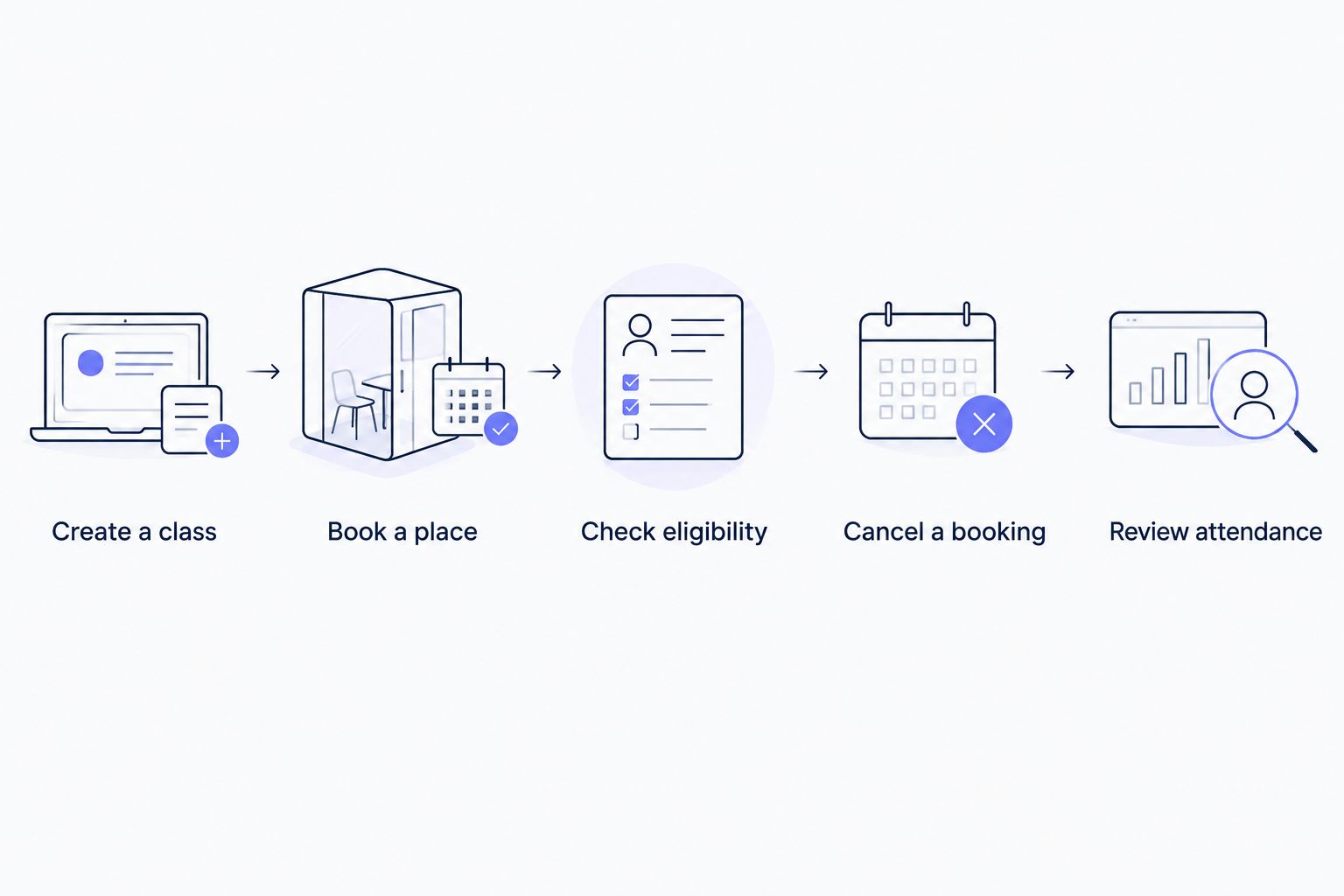
For private lessons, replace the shared-capacity check with instructor availability and intake review. Keep the rest of the test: a booking is not fully assessed until staff can find it, change it and handle a cancellation.
Write down every manual intervention during the demonstration. That record gives you a practical comparison without relying on an invented rating system.
Which yoga scheduling software should you choose?
Choose TeamUp as the default shortlist option for recurring group classes and memberships. Choose Mindbody when marketplace discovery is also a defined requirement, and Acuity Scheduling when private-lesson intake drives the decision.
Choose Calendra for yoga scheduling when your priority is letting customers book appointments online, 24/7. Keep group capacity, membership eligibility and waitlists as separate acceptance checks if your studio needs them.
In 2026, the right choice is the system that completes your booking workflow without leaving essential decisions outside it. Do not buy a larger operating model than you need, or a simpler one that leaves your core work unresolved.
Explore online appointment booking
See appointment scheduling for studios and other service businesses.
FAQ
What's the best scheduling software for yoga studios in 2026?
TeamUp is the default shortlist choice for yoga studios centred on recurring group classes and memberships. Choose by booking model: simple appointments, marketplace discovery and intake-led private lessons have different requirements.
Is appointment software enough for a yoga studio?
Appointment software fits a yoga studio whose core service is individual booked sessions. Group classes also require checks for shared capacity, attendance eligibility and cancellations.
Can customers book studio appointments outside opening hours?
Calendra lets customers book appointments online, 24/7. Keep the ability to submit a booking separate from the actual session times your studio offers.
Is TeamUp better than Acuity Scheduling for yoga classes?
TeamUp is the stronger starting point for recurring group classes and membership management. Acuity Scheduling is the more relevant shortlist option when private appointments and intake forms drive the requirement.
Should a yoga studio choose Mindbody for discovery?
Mindbody belongs on the shortlist when a consumer marketplace is part of the studio's booking strategy. Marketplace presence does not guarantee bookings, so assess local relevance and the direct booking workflow too.
How do I test yoga class scheduling software?
Create a class, book a place, check attendance eligibility, cancel a booking and review the resulting attendance record. Use the same scenario across each shortlisted platform so the comparison reflects your operating rules.
What should private yoga instructors prioritise?
Private yoga instructors should prioritise appointment booking, instructor availability and the information needed before a lesson. Test intake forms when that information must be collected during scheduling.
One last thing
Test the cancellation before approving the booking system. A successful reservation shows that a student can enter the schedule; a cancellation reveals how the system handles released capacity, attendance rights and staff follow-up.
Make that your final acceptance test. The awkward booking is more informative than the easy one.